A photo of the village mentioned in this article
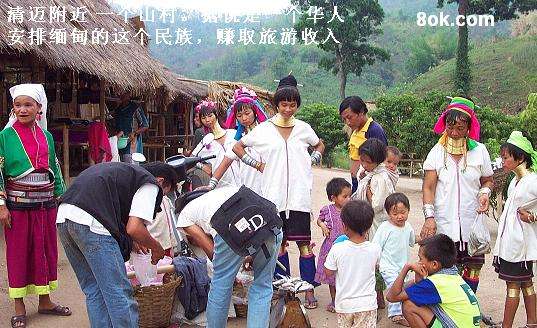
The Long neck Karen (Karen-Padaung) are not actually Karen at all, but
they are also refugees, escaping the genocidal madness in Burma. They have
become a symbol of tourism in Thailand's Mae Hong Son province. On the
Burmese side of the border, agents of the junta gather the Karen, Akha,
Lihsu, Lahu and other tribal people into human zoos.
In Burma's Tachylek, I watched in nauseated amazement as drunken Chinese
businessmen, exhausted from long nights of gambling, strolled through
these Disney-like villages, accompanied by their prostitute girl friends,
snapping photos of the"Tribal People in natural habitat." Each village
maintained one family from each tribe, wearing their traditional dress,
and living in an authentic tribal house. The village was a real
time-saver, as you didn't have to travel to have your photo made with one
representative of each tribe.
The"cultural villages" like the one in Tachylek, are easily the most
horrible and flagrant exploitation of human rights I have ever witnessed.
On the Thai side of the border, the Padaung are also exploited, but not to
such a degree as inside of their home country, Burma.
Because of the popularity of these villages as a tourist destination, a
number of people have written me and asked abut the true life of the
tribal people. In other words, they wanted to know how the Padaung live
when they are not on display in a synthetic village. The truest answer I
could give is that I have spent considerable time living among the Shan.
But, I have never lived among the Padaung. There are rumors that there
are no more Padaung living in traditional villages. Word on the border is
that the Padaung were a vary small group to start with. Nearly
one-hundred percent of those who make it to Thailand wind up in tourist
villages. Today, nearly all of those living in Burma have been rounded up
and forced to live in"cultural villages."
I think no one knows for sure, because it is so hard for researchers to
live inside of Burma, but I have heard that there are no more true,
non-touristic Padaung villages.(This needs to be verified. If anyone has
information to the contrary, please, by all means, write to me
[email protected])
What I do know about the Padaung, I will share, in the hopes of brining
attention to this horrible exploitation, and as a way of demonstrating
that the victims of the junta are countless. It never ends. Life, after
life, after innocent life is destroyed by this repressive regime which
cares only for its own survival.
There are two closely related groups, who often occupy the same tourist
villages in Thailand. There are the long neck Karen, and the big ear
Karen. The big ear Karen put large earrings in their ears to make the
lobes bigger. They also force rings on their claves. They add one ring to
their calves every year, as the Long Neck do with their neck rings.
As far as anyone knows, Padaung women in Burma still keep this tradition,
but the total population of Padong is extremely small. There could be only
a few hundred of them, or maybe as many as a couple of thousand. Either
way, the number is small, but they keep their tradition. Some interviews,
which a friend of mine conducted in Burma suggested that many of the girls
in the Burmese"cultural villages" were actually actresses. The Akha girl
may have actually been Lihsu or from some other tribe. She was told to put
on a costume and live in a certain hut, and she did it.
In my own interviews, on the Thai side of the border, we were told that
some girls were either not actually Padaung, or were from a group that
didn't normally wear the rings. But, they put on the rings just to get put
in the human zoo, rather than be sent back to Burma. We were also told
that to make the look more exotic for tourists, the girls were forcing one
new ring on their neck every nine months, instead of once per year.
Although it may have seemed a safer alternative to returning to the war in
Burma, the tourist village, is a sad pathetic place. The people have no
normal life at all. According to their culture, they are supposed to be
doing rice farming and raising their families, but instead they stand
there selling trinkets and posing for photos. Most of the women we spoke
to were quite nice, and willing to talk, but they spoke Thai to varying
degrees only, so communication was often a problem. They were afraid to
talk to us at length because the Puyai Bans (pesanovante Thai/Chinese who
run the village and collect the money) obviously told them not to talk to
foreigners or journalists. The pesanovante would often crowd in and try to
eavesdrop or outright intimidate us.
The tourists were horribly ignorant people who believed that these long
neck were part of Thailand or Thai culture, but of course they are
refugees from the war in Burma and shouldn't be in Thailand at all. They
are only tolerated by the Thais because they can exploit the women and
make money.
If you ask about wearing the rings, most of the girls will tell you that
it is not painful, but they are lying. The rings must be painful, because
they are forcing their clavicles down and extending the cervical
vertebrae. There have been cases of adult women putting on rings just to
get into these villages and not be deported to the war. Obviously forcing
a bunch of rings onto a grown woman would be painful.
I don't live with Padong or with Karen. I live with Shan. So, I only
visited Padaung villages, and sometimes work with Karen soldiers in the
field. So, I never got to actually see the rings being put on the girls.
Again it is important to note that there is no real anthropological
connection between Karen and Padaung.
The rings are normally not removed during the entire lifetime of the
girls. I have heard that they could actually die if the rings are removed,
because the cervical spine will not be strong enough to support the head.
In one of the villages, a girl, named Sempre, took her rings off to try
and pass for"normal." She is definitely in danger of suffering a spinal
injury. She might get away with it, physically, since she is so young,
less than twenty. Culturally, however, she will never recover. The women
who still wear rings have ostracized her for breaking with the culture.
Now she doesn't receive an income from the puyai bans because she is no
longer an attraction. She hopes to get an ID card and go to work in the
city, but she could quite easily be arrested and deported now.
As I stated earlier, I don't have a good number on how many Padaung exist
on both sides of the border, but, I would estimate about 50 women live in
each tourist village, on the Thai side. On the Burmese side, there is
normally only one very lonely family from each tribe. In the whole world,
however, there are very few long neck. In Thailand there are none in
refugee camps, they all get caught and are forced to work in the tourist
villages. Once when I was in Ban Thaton, and I saw a long neck Karen women
walk out of the jungle to buy food at a hill tribe market. When I raised
my camera, everyone asked me not to photograph her because it would
jeopardize her freedom. She was one of very,
very few long neck hiding in the jungle and living freely.
A common question people ask is why the women wear the rings. I have heard
several reasons. One is that, in Padaung culture, the rings are considered
attractive. Anther reason I heard was that if a man wanted a divorce he
had the right to take the rings off his wife, which would instantly kill
her. I don't know the reason and I don't know if anyone does. The women
didn't know when I asked them. It was a typical Asia moment when I asked,
the girls answered."Someone told us once why we wear the rings, but I
forgot."
People ask me if the rings are healthy, or if the girls could die of
infection. Well you can't die from an allergic reaction to jewelry.
Remember the rings are worn on top of the skin. There is no piercing.
Tribal people, or anyone living in the jungle, are absolutely infested
with skin parasites and infections. This is just normal. Like head lice,
it is just something they live with and believe to be a normal part of
every day life. At best, they wash with cold water once per day, hiking
God knows how far into the jungle to take a"bath." You are already filthy
when you come back from the bath. But some don't have access to any water,
so they just stay dirty.
If girls have died because of the rings, it wasn't recorded. Tribal people
accept death as a normal part of life and wouldn't record, or think about,
or worry about something like that. The culture says wear the rings, so
they wear the rings, end of story.
The war in Burma has been going on for sixty years. It is estimated that
more than two million people have been made homeless and are now living in
camps in Thailand, Bangladesh, India, and Malaysia. These long neck are
the most visible refugees, but there are so many others. The Burman's only
comprise about 40% of the population of Burma. The rest is made up of
various ethnicities, tribes who are being subjected to genocide. They need
help. They need the UN and USA to intervene militarily. You can google my
name, plus the words Shan State Army and see the work I have done with the
Shan people. At the end of every Burma video I remind people to"Please,
say a prayer for the people of Burma."
Antonio Graceffo is a qualified Emergency Medical Technician, as well as
an adventure and martial arts author living in Asia. He is the Host of the
web TV show,"Martial Arts Odyssey," Currently he is working inside of
Shan State, documenting human rights abuses, doing a film and print
project to raise awareness of the Shan people. To see all of his videos
about martial arts, Burma and other countries:
http://youtube.com/results?search_query=antonio+graceffo&search=Search
Antonio is the author of four books available on amazon.com Contact him
[email protected]
see his website http://speakingadventure.com/burma.htm
Antonio is self-funded and seeking sponsors. If you wish to contribute to
the"In Shanland" film project, you can donate through paypal, through the
Burma page of my website.
http://speakingadventure.com/burma.htm

