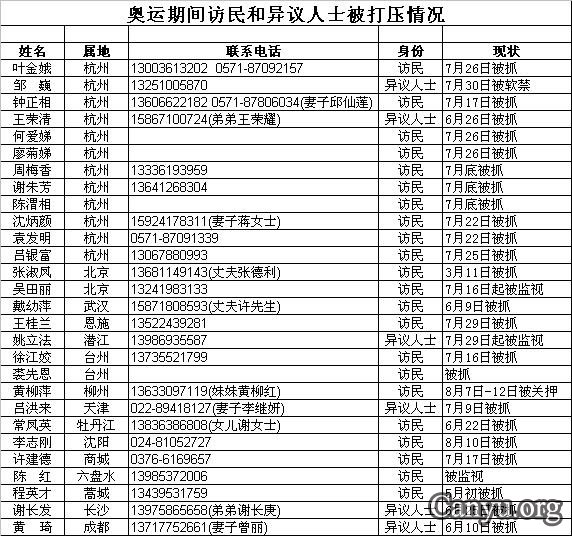
This is a summary of arrested petitioners investigated by canyu.org:
Increasing Repression of Activists, Media Sources; No Protests Approved Yet
(New York, August 13, 2008) - The Chinese government is detaining a rights
activist who applied to demonstrate legally in designated "protest zones"
established for the Beijing Olympics, Human Rights Watch said today.
Ji Sizun, 58, a self-described grassroots legal activist from Fujian
province, was arrested on August 11, 2008. On August 8, Ji had applied to
the Deshengmenwai police station in Beijing's Xicheng District for a permit
to hold a protest in one of the city's three designated "protest zones." In
his application, Ji stated that the protest would call for greater
participation of Chinese citizens in political processes, and denounce
rampant official corruption and abuses of power. He was arrested after
checking back at the police station on the status of his application,
witnesses told Human Rights Watch.
"The Chinese government should immediately release Ji Sizun and anyone else
detained by police while trying to exercise their basic rights," said
Sophie Richardson, Asia advocacy director at Human Rights Watch. "The
protest application process clearly isn't about giving people greater
freedom of expression, but making it easier for the police to suppress it."
Eyewitnesses said Ji entered the police station at around 10:45 a.m. on
August 11. At 12:15 p.m., he was escorted out of the building and put into
a dark-colored, unmarked Buick by several men who appeared to be
plainclothes policemen. Ji managed to make a short call to his family to
notify them he had "problems," but has since disappeared and remains
unreachable on his mobile phone.
Public demonstrations critical of the Chinese government routinely reap
swift and harsh retribution from state security forces. On July 23,
however, the Beijing Organizing Committee for the Olympic Games (BOCOG)
security director, Liu Shaowu, announced the creation of three protest
zones in Beijing parks. He told reporters that: "People or protesters who
want to express their personal opinions can go to do so" in line with
"common practice in other countries."
The process, however, is more restrictive than in many countries that use
pre-designated protest areas. Applicants must give formal notification at
least five days in advance, subject to police approval, which could be
withdrawn at any time. Other conditions imposed by the government on the
protest zones disqualify the majority of Chinese citizens from even
applying for the right to use the areas. Non-Beijing residents are
prohibited from protesting. Protests which might harm "national unity" and
"national, social or collective interests" are also legally forbidden
without any clarification of what might constitute a violation of these
broad terms.
The three protest zones have so far remained empty of demonstrators.
"Nobody should confuse the lack of protesters with a lack of complaints,"
said Richardson. "The detention and harassment of those who tried to take
the government at its word shows the lengths to which the authorities will
go to keep people from peacefully expressing their views."
Other Chinese citizens have attempted to apply for permission and instead
been harassed or detained in recent days. They include the following:
- Dr. Ge Yifei, a 48-year-old doctor from Suzhou, was detained in Beijing
by Suzhou government officials who had followed her to the capital, where
she was attempting to apply for permission to protest about a property
dispute in her home town. The officials held Ge for several hours and then
forcibly escorted her back to Suzhou.
- Police at Beijing's Haidian district police station refused to accept an
application by Zhang Wei in late July to protest over the demolition of her
home for Olympics-related development. On August 12, Zhang's son Mi Yu told
the Associated Press that the district court had sentenced Zhang to a month
in prison for "disturbing social order" in connection with a small protest
Zhang took part in last week in Beijing's Qianmen district with around 20
of her former neighbors.
- Representatives of parents wanting to protest in Beijing about the deaths
of their children in the May 12 Sichuan earthquake were intercepted at
Chengdu airport by police who "tore up their (airline) tickets," the
Washington Post reported on August 6 (
http://www.washingtonpost.com/wp-dyn/content/article/2008/08/05/AR2008080503197.html
).
Beijing police arrested Tang Xuecheng in early August when he applied for
permission to protest local corruption in his native Hunan province, The
Australian newspaper reported on August 12 (
http://www.theaustralian.news.com.au/beijing_olympics/story/0,27313,24166771-5014104,00.html
).
Human Rights Watch said these incidents are occurring against a backdrop of
intensifying official reprisals against Chinese citizens who are critical
of the government in interviews with foreign journalists, and of strict
police surveillance of prominent dissidents and activists in Beijing. ( . .
. )
On August 7, Zeng Jinyan, the wife of a high-profile human rights activist,
ceased to communicate with friends and relatives. Her husband, Hu Jia, was
jailed for three and a half years on April 3 on charges of "inciting
subversion against the state" (
http://www.hrw.org/english/docs/2008/02/26/china18152.htm ). Zeng had not
indicated any intention to suspend communications, but had earlier told
friends that police had told her to leave Beijing ahead of the Olympic
Games inauguration on August 8. Those individuals believe she has been
detained by police for the duration of the games.
Human Rights Watch has compiled a list of more than 30 dissidents who are
currently subject to a variety of restrictions imposed by the police,
including permanent police surveillance, restrictions on communications and
movements, house arrest, and in certain cases detention. The list includes
lawyers such as Teng Biao, Li Fangping and Zhang Xingshui; independent
intellectuals, such as Liu Xiaobo and Liu Junning; house church activists,
such as Zhang Mingxuan; housing rights activists, such as Ye Guozhu; rights
activists, such as Li Baiguang and Qi Zhiyong; and relatives of political
prisoners, including Yuan Weijing, the wife of blind legal activist Chen
Guangcheng, and Jia Jianying, the wife of democracy activist He Depu. All
have been warned explicitly by police or state security agents against
talking to foreign journalists.
"The International Olympic Committee and world leaders who honored Beijing
by attending the opening ceremonies shouldn't play deaf, dumb, and blind
while people are hauled off for peaceful criticism," said Richardson.
"China is suppressing free expression, despite its Olympic pledge not to do
so, and the question is whether the rest of the world silently accepts
that."
For more Human Rights Watch reporting on the human rights situation in
China during the Beijing Olympics, please visit: http://china.hrw.org/

